
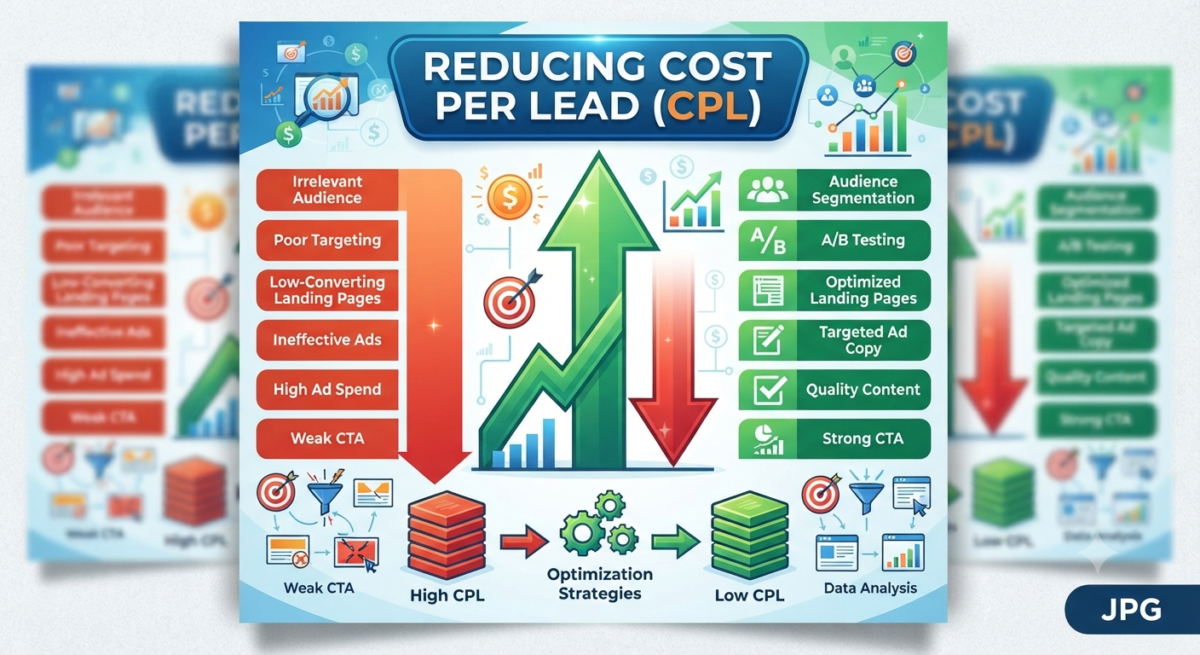
Every business wants more qualified leads without continuously increasing its advertising budget. Whether you invest in Google Ads, social media campaigns, SEO, or email marketing, one metric significantly impacts your return on investment Reducing Cost Per Lead. Lowering your cost per lead allows you to generate more opportunities while spending the same marketing budget, helping your business grow more efficiently.
Many marketers believe that simply lowering advertising costs will solve the problem. In reality, successful lead generation depends on multiple factors working together. Audience targeting, landing page experience, ad relevance, website speed, user trust, and conversion optimization all contribute to your overall cost per lead. Improving these areas can dramatically increase campaign performance without requiring a larger budget.
This guide explains proven strategies used by experienced marketing professionals to reduce lead acquisition costs while maintaining lead quality. Instead of relying on shortcuts, you’ll learn sustainable techniques that continue producing results over time.
What Is Cost Per Lead (CPL)?
Cost Per Lead, commonly known as CPL, measures how much money a business spends to generate one qualified lead.
The calculation is straightforward:
Cost Per Lead = Total Marketing Spend ÷ Total Leads Generated
For example, if your company spends $2,000 on advertising and receives 100 qualified leads, your CPL equals $20.
This metric helps businesses understand marketing efficiency. A lower CPL generally means your campaigns generate leads more economically. However, reducing costs should never come at the expense of lead quality. A campaign that produces inexpensive but unqualified leads often performs worse than one with a slightly higher CPL and stronger conversion rates.
Successful businesses balance cost, lead quality, and customer lifetime value instead of focusing solely on the lowest possible CPL.
Why Your Cost Per Lead May Be Too High
Many companies experience rising advertising costs without realizing the root causes. Understanding these issues is the first step toward improving campaign performance.
One common reason is poor audience targeting. When advertisements reach people who have little interest in your products or services, clicks increase but conversions remain low. Every irrelevant click consumes part of your marketing budget.
Another major issue involves weak landing pages. Even an excellent advertisement cannot compensate for a confusing or slow website. Visitors expect fast loading times, clear messaging, trust signals, and simple contact forms. If these elements are missing, potential customers often leave before submitting their information.
Low-quality ad creatives also contribute to higher CPL. Generic headlines and unclear calls to action reduce engagement, forcing advertisers to spend more to achieve the same results.
Businesses frequently overlook mobile optimization as well. Since most users browse on smartphones, poor mobile experiences often lead to higher bounce rates and fewer conversions.
Finally, many organizations fail to analyze campaign data regularly. Without monitoring performance metrics, ineffective campaigns continue consuming budget while better-performing opportunities remain unnoticed.
Proven Strategies for Reducing Cost Per Lead
Reducing your CPL requires continuous optimization rather than one-time improvements. The following strategies consistently deliver measurable results across multiple industries.
Improve Audience Targeting
Effective marketing begins with understanding your ideal customer.
Instead of targeting broad audiences, build detailed customer profiles based on demographics, purchasing behavior, interests, geographic location, and previous interactions with your business.
Platforms such as Google Ads and Meta Ads provide advanced audience segmentation features that allow advertisers to reach users most likely to convert. Combining first-party customer data with behavioral targeting often produces significantly higher conversion rates.
Lookalike audiences can also improve campaign performance by identifying new users who share characteristics with your existing customers.
As targeting becomes more accurate, irrelevant clicks decrease while qualified leads increase naturally.
Optimize Landing Pages
Landing pages play a critical role in lead generation success.
Visitors decide within seconds whether they trust your business. A professional design, clear value proposition, compelling headline, and simple contact form create confidence immediately.
Each landing page should focus on one objective. Too many navigation options or competing offers often distract visitors from completing your desired action.
Trust indicators such as testimonials, customer reviews, certifications, security badges, and case studies help reduce hesitation and improve conversion rates.
Fast page speed is equally important. Every additional second of loading time increases the likelihood that visitors abandon the page before converting.
Regular testing of headlines, page layouts, form length, and calls to action allows marketers to continuously improve performance.
Increase Conversion Rates
Reducing cost per lead often depends more on improving conversion rates than lowering advertising costs.
Imagine two businesses spending the same advertising budget. One converts two percent of visitors, while the other converts six percent. The second business naturally achieves a much lower CPL because more visitors become leads without increasing spending.
Simple improvements can make a significant difference.
Clear headlines explain exactly what visitors receive.
Persuasive copy addresses customer pain points instead of focusing only on product features.
Strong calls to action encourage immediate responses by communicating clear benefits.
Reducing unnecessary form fields minimizes friction and increases completion rates.
Businesses should also ensure every page functions perfectly on desktop, tablet, and mobile devices.
Improve Ad Quality Score
For Google Ads campaigns, Quality Score directly affects advertising costs.
Google rewards advertisers who create relevant advertisements and positive user experiences. Higher Quality Scores often result in lower cost per click while improving ad positions.
To improve Quality Score, ensure keywords closely match advertisement copy and landing page content.
Write compelling headlines that answer user intent clearly.
Use keyword-rich descriptions naturally without keyword stuffing.
Maintain fast-loading landing pages and strong mobile usability.
Continuously remove underperforming keywords while expanding campaigns using high-converting search terms.
Over time, improved Quality Scores reduce advertising expenses while generating more qualified leads.
A/B Test Ads and Landing Pages
One of the most effective ways to improve marketing performance is through continuous A/B testing. Instead of assuming which version of an advertisement or landing page will perform better, businesses should rely on real user data.
A/B testing involves creating two versions of the same marketing asset while changing only one element at a time. This could include the headline, call-to-action button, hero image, contact form length, pricing presentation, or page layout. After collecting enough data, marketers can identify which version generates more qualified leads.
Many businesses make the mistake of redesigning an entire page at once. Doing so makes it difficult to determine which specific change influenced the results. Testing one variable at a time provides accurate insights and creates a repeatable optimization process.
Successful companies treat optimization as an ongoing activity rather than a one-time project. Even small improvements in conversion rates can significantly lower acquisition costs over several months.
Use Retargeting Campaigns
Most website visitors do not convert during their first visit. They may still be researching, comparing competitors, or waiting for internal approval before making a decision.
Retargeting allows businesses to reconnect with these visitors through carefully planned advertising campaigns.
Because these users are already familiar with your brand, they usually require less persuasion than completely new prospects. This often results in higher conversion rates and lower acquisition costs.
Effective retargeting focuses on delivering value instead of repeatedly displaying the same advertisement. Businesses can remind visitors about unfinished enquiries, offer educational resources, highlight customer success stories, or present limited-time offers that encourage action.
Segmenting retargeting audiences also improves campaign performance. Someone who visited a pricing page should receive different messaging than someone who only viewed a blog article.
Personalized communication increases relevance, improves engagement, and generates higher-quality leads.
Optimize Your Marketing Budget
Increasing your advertising budget does not automatically increase profitability.
High-performing organizations allocate resources based on measurable results instead of assumptions.
Review campaign performance regularly and identify channels producing the strongest return on investment. If one platform consistently delivers qualified leads at a lower cost, increasing investment there may generate better results than spreading the budget equally across every channel.
Marketing attribution also plays an important role. Customers often interact with multiple touchpoints before becoming leads. Understanding which channels contribute throughout the buying journey helps businesses invest more effectively.
Budget optimization should always be supported by analytics, conversion tracking, and regular reporting rather than intuition.
Focus on High-Intent Keywords
Search intent has become one of the most important ranking and advertising factors.
Many companies spend large budgets targeting broad informational keywords that attract visitors with little purchasing intent.
Instead, focus on keywords that indicate users are actively searching for solutions or services.
Examples include phrases containing words such as “services,” “company,” “near me,” “pricing,” “quote,” “consultation,” or “hire.”
These searches typically produce visitors who are much closer to making a buying decision.
Long-tail keywords also deserve attention. Although they generally have lower search volume, they often produce significantly higher conversion rates because they match user intent more precisely.
Creating dedicated landing pages around high-intent search queries improves both organic rankings and paid advertising performance.
SEO vs Paid Ads for Better Lead Generation
Businesses often debate whether they should invest in SEO or paid advertising.
The reality is that both channels perform best when working together.
Paid advertising delivers immediate visibility. Campaigns can begin generating traffic within hours, making them valuable for new product launches, seasonal promotions, or competitive industries.
SEO, on the other hand, builds sustainable long-term visibility. High-quality content continues attracting qualified visitors without paying for every click.
An effective digital marketing strategy combines both approaches.
SEO builds authority, trust, and consistent organic traffic.
Paid advertising fills immediate demand while supporting campaigns for competitive commercial keywords.
Businesses that integrate both channels generally achieve more stable lead generation while reducing dependence on any single traffic source.
Best Tools to Monitor Marketing Performance
Accurate measurement forms the foundation of continuous improvement.
Google Analytics 4 provides valuable insights into visitor behaviour, user engagement, conversion paths, and event tracking.
Google Ads helps advertisers monitor click-through rates, Quality Score, conversion costs, keyword performance, and campaign efficiency.
Meta Ads Manager offers detailed reporting for Facebook and Instagram campaigns, allowing businesses to optimize audience targeting and creative performance.
Customer Relationship Management systems such as HubSpot, Salesforce, Zoho CRM, and Bitrix24 help organizations evaluate lead quality beyond initial conversions. Understanding which marketing channels produce actual customers instead of simple enquiries allows for better investment decisions.
Call tracking software also benefits service-based businesses by measuring phone enquiries generated through marketing campaigns.
Combining these tools provides a complete picture of marketing performance instead of relying on isolated metrics.
Common Mistakes That Increase Marketing Costs
Many businesses unknowingly increase acquisition costs through avoidable mistakes.
One common issue is sending all advertising traffic to the homepage. Visitors often struggle to find relevant information because homepages serve multiple purposes. Dedicated landing pages usually convert much better.
Another mistake involves ignoring website speed. Slow-loading websites frustrate users and increase bounce rates, especially on mobile devices.
Poor mobile optimization remains another significant problem. Modern users expect seamless experiences regardless of screen size.
Businesses also underestimate the importance of trust. Missing reviews, testimonials, certifications, guarantees, or clear contact information reduce visitor confidence.
Running campaigns without conversion tracking creates another serious challenge. Without reliable data, marketers cannot identify which advertisements generate real business results.
Finally, many companies stop optimizing campaigns after launch. Digital marketing requires continuous testing, refinement, and analysis to remain competitive.
Key Metrics to Track Alongside CPL
Successful marketers never evaluate performance using only one metric.
Conversion Rate measures the percentage of visitors who become leads. Higher conversion rates generally indicate stronger campaign effectiveness.
Cost Per Click helps advertisers understand how efficiently they attract website visitors.
Customer Acquisition Cost measures the total expense required to gain one paying customer rather than simply generating a lead.
Return on Ad Spend evaluates overall advertising profitability by comparing revenue against marketing investment.
Lead Quality is equally important. Generating hundreds of inexpensive but unqualified leads rarely supports business growth. Sales teams should regularly provide feedback regarding lead quality so marketing campaigns can improve targeting over time.
Tracking these metrics together provides a more accurate understanding of overall marketing success.
Future Trends Shaping Lead Generation
Digital marketing continues evolving rapidly.
Artificial intelligence is transforming campaign optimization by automatically adjusting bids, identifying audience segments, predicting customer behaviour, and generating performance insights.
First-party data will become increasingly valuable as privacy regulations reduce access to third-party tracking information. Businesses that build strong customer databases through email subscriptions, loyalty programs, and valuable content will gain competitive advantages.
Marketing automation will also continue improving efficiency by delivering personalized communication throughout the customer journey.
Voice search, conversational search, and AI-powered search experiences are changing how users discover businesses online. Creating comprehensive, experience-based content that directly answers user questions increases the likelihood of appearing in featured snippets and AI-generated search results.
Businesses that consistently publish trustworthy, well-structured, and authoritative content will remain competitive as search technology evolves.
Conclusion
Reducing marketing costs without sacrificing lead quality is achievable when businesses focus on continuous improvement rather than quick fixes.
Successful lead generation depends on understanding customer intent, creating exceptional landing pages, improving conversion rates, refining audience targeting, testing campaigns regularly, and making informed decisions based on accurate data.
Instead of chasing vanity metrics, businesses should measure long-term performance, customer value, and campaign profitability. Small improvements across multiple areas often produce significant results over time.
The most successful organizations treat optimization as an ongoing process. They learn from customer behaviour, adapt to market changes, and continually refine every stage of the marketing funnel.
By implementing the strategies discussed throughout this guide, businesses can build a scalable lead generation system that delivers sustainable growth while making every marketing dollar work harder.
Frequently Asked Questions
What is considered a good Cost Per Lead?
A good Cost Per Lead depends on your industry, target audience, and customer lifetime value. For some businesses, a CPL of $15 is excellent, while others may find $150 profitable if each customer generates substantial long-term revenue. The most important factor is whether your leads consistently convert into paying customers.
How can small businesses lower their marketing costs?
Small businesses can improve campaign efficiency by targeting specific audiences, creating dedicated landing pages, optimizing website speed, improving ad quality, and regularly testing marketing campaigns. Investing in SEO also helps generate consistent organic traffic, reducing reliance on paid advertising over time.
Does SEO help generate more affordable leads?
Yes. SEO attracts users who are actively searching for products or services, making organic traffic one of the most cost-effective long-term marketing channels. High-quality content, technical SEO, and a strong user experience help businesses generate qualified enquiries without paying for every click.
Why are landing pages important for lead generation?
Landing pages focus visitors on a single objective, reducing distractions and improving conversion rates. A well-designed landing page with clear messaging, trust signals, and an easy-to-complete contact form encourages more visitors to become qualified leads.
How often should marketing campaigns be optimized?
Marketing campaigns should be monitored continuously and reviewed weekly or monthly, depending on campaign size and budget. Regular optimization helps identify underperforming ads, improve conversion rates, refine audience targeting, and maximize return on investment.
Which metrics should be monitored besides Cost Per Lead?
Businesses should monitor Conversion Rate, Customer Acquisition Cost (CAC), Return on Ad Spend (ROAS), Click-Through Rate (CTR), lead quality, customer lifetime value, and overall revenue generated from marketing campaigns. These metrics provide a complete picture of campaign performance.
Real-World Success Comes from Continuous Optimization
The most successful businesses rarely achieve exceptional marketing results overnight. They consistently test new ideas, analyze customer behavior, improve user experiences, and refine every stage of their marketing funnel. Every improvement, no matter how small, contributes to stronger long-term performance.
Whether your goal is generating more enquiries, increasing conversion rates, or improving overall marketing efficiency, sustainable growth comes from making informed decisions based on data rather than assumptions.
Case Studies That Inspire Better Marketing Decisions
Looking at real business results is one of the fastest ways to understand what works in digital marketing. Successful case studies demonstrate how strategic SEO, conversion optimization, paid advertising, and user experience improvements can transform business performance.
At Bhatti Marketing, every case study focuses on practical implementation rather than theory. Instead of discussing generic marketing concepts, each project explains the client’s challenges, the strategies implemented, the optimization process, and the measurable business outcomes achieved.
Studying real campaigns helps businesses avoid common mistakes, identify opportunities for growth, and implement proven strategies with greater confidence.
Ready to Improve Your Marketing Performance?
If your business is generating traffic but not enough qualified enquiries, now is the time to optimize your digital marketing strategy.
The right combination of SEO, paid advertising, conversion rate optimization, content marketing, and landing page improvements can help you maximize every marketing investment while attracting higher-quality prospects.
The experienced team at Bhatti Marketing works with businesses to develop customized digital marketing strategies that focus on measurable growth instead of vanity metrics. From technical SEO and high-converting content to PPC optimization and conversion-focused websites, every solution is designed to deliver long-term business success.
Explore our latest case studies to see how data-driven marketing strategies have helped businesses improve visibility, increase qualified leads, and achieve sustainable growth. When you’re ready to take the next step, our team is here to help you build a marketing strategy that delivers real, measurable results.