
Introduction: Understanding Lookalike Audiences in Digital Marketing
Lookalike Audiences Explained is an important concept for businesses that want to reach new customers through smarter advertising strategies. In modern digital marketing, brands no longer depend only on broad targeting because customer behavior, interests, and online activities provide valuable insights. A lookalike audience helps marketers find people who share similar characteristics with their existing customers.
For businesses investing in paid advertising, finding the right audience can decide whether a campaign succeeds or wastes budget. Instead of showing ads to random users, marketers can use existing customer information to discover new potential buyers who are more likely to engage, purchase, or take action.
This approach has become popular among advertisers because it combines data analysis with audience targeting. Platforms use customer signals such as interests, actions, engagement patterns, and demographics to identify people who behave similarly to an existing audience.
When used correctly, this strategy helps brands increase visibility, improve campaign performance, and create a more personalized advertising experience.
What Is a Lookalike Audience?
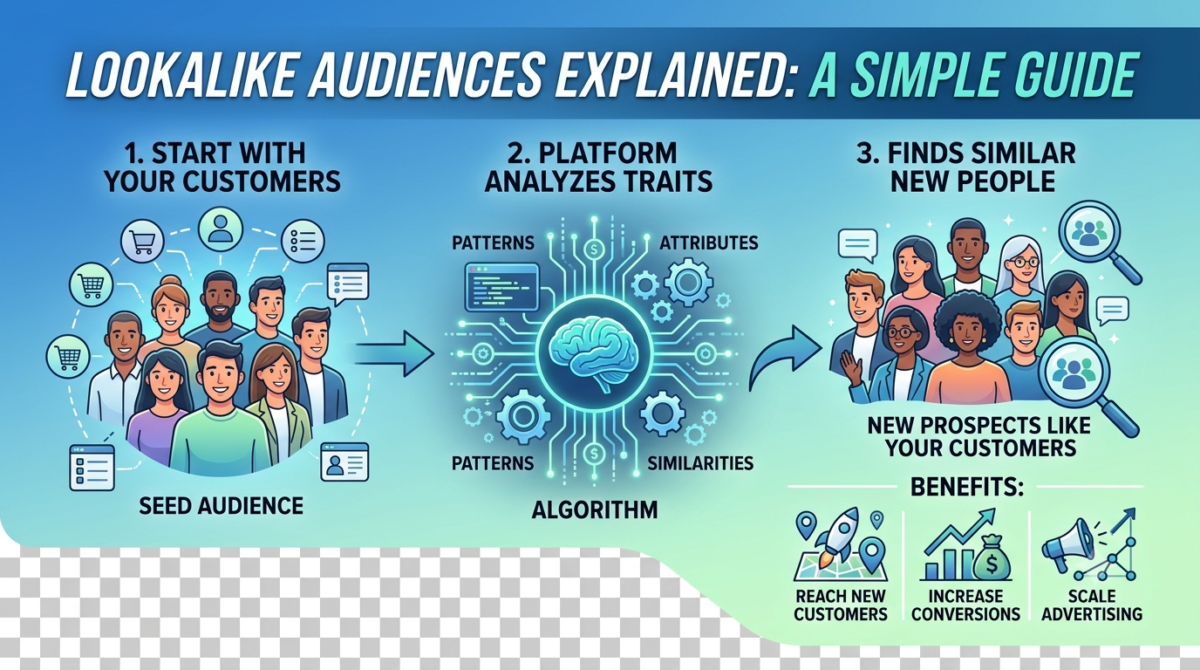
A lookalike audience is a group of new users who share similar characteristics with an existing audience. Marketers create this audience by providing a source group, such as previous customers, website visitors, app users, or people who interacted with a brand.
The advertising platform then studies the source audience and finds common patterns. These patterns may include browsing habits, purchasing behavior, interests, location, age group, and online engagement.
The goal is simple: reach people who have a higher chance of becoming customers because they resemble people who already showed interest in the business.
For example, an online clothing store may have a list of customers who purchased products in the past. The platform analyzes this group and finds other users with similar behaviors. The business can then advertise to this new audience instead of starting from zero.
This makes advertising more efficient because the campaign focuses on users who match proven customer profiles.
How Lookalike Audiences Work
Creating a successful audience starts with a strong source audience. The quality of the original data directly affects the quality of the new audience.
A source audience can come from different places. Businesses may use customer lists, website visitors, people who completed forms, video viewers, or users who interacted with social media content.
Once the source data is selected, the advertising platform analyzes the information. Advanced algorithms compare thousands of signals to understand what makes these users similar.
The platform does not copy the exact people from the original list. Instead, it identifies patterns and finds new users with matching behaviors.
For example, if your existing customers frequently visit specific pages, purchase certain products, or engage with certain types of content, the system looks for people showing similar activities.
This process allows advertisers to expand their reach while maintaining a connection with their ideal customer profile.
Why Businesses Use Lookalike Audiences
Many businesses struggle with finding the right audience. Traditional advertising methods often target large groups based on basic interests, but they may include many users who are not interested in the product or service.
Lookalike targeting solves this problem by using real customer data. Instead of guessing who might be interested, businesses use information from people who already interacted with their brand.
This method can support different marketing goals. A company may use it to increase sales, generate leads, grow website traffic, promote services, or improve brand awareness.
Another advantage is scalability. When a business discovers a profitable customer group, it can expand beyond the original audience and reach more potential customers.
For example, a small business may have hundreds of successful customers. A similar audience strategy helps that business find thousands of possible customers who share similar characteristics.
Benefits of Using Lookalike Audiences
Lookalike audiences provide several advantages for modern advertising campaigns.
The first benefit is improved targeting accuracy. Businesses can focus their budget on users who have a stronger possibility of conversion. This reduces unnecessary spending and improves advertising efficiency.
Another benefit is better customer acquisition. Instead of waiting for customers to discover a brand naturally, companies can actively reach people who are likely to need their products or services.
This strategy also supports testing and optimization. Marketers can create different audience groups and compare results to understand which segments perform better.
A strong audience strategy also helps improve the customer journey. When ads reach relevant users, people are more likely to interact with the content and build trust with the brand.
Lookalike Audiences Compared With Other Targeting Methods
Many advertisers use different audience strategies depending on their goals. Lookalike targeting is different from traditional interest-based targeting because it uses real customer behavior rather than general assumptions.
Interest targeting focuses on people who follow specific topics, categories, or hobbies. However, someone interested in a topic does not always mean they will buy a product.
Remarketing focuses on people who already visited a website or interacted with a brand. It is useful for bringing back potential customers who did not complete an action.
Lookalike targeting works between these approaches. It helps businesses reach new people while using information from existing customers.
The best advertising campaigns often combine multiple strategies to create a balanced approach.
How to Create a Lookalike Audience
The process begins by selecting the right source audience. Businesses should choose data that represents valuable customers rather than random visitors.
A customer list with previous buyers is often stronger than a general website visitor list because it reflects actual purchasing behavior.
After selecting the source, marketers choose the audience size. A smaller audience usually creates closer matches, while a larger audience provides wider reach.
Testing different audience sizes helps identify the best balance between accuracy and scale.
Campaign performance should also be monitored regularly. Audience behavior can change over time, so businesses should review results and update their targeting strategy.
Best Practices for Lookalike Audiences
Building an effective audience requires more than simply creating a new targeting group. The success of a campaign depends on the quality of data, testing process, and ongoing improvements.
One important practice is using accurate source information. If the original audience contains irrelevant users, the platform may create a less effective audience. Businesses should focus on customers who completed valuable actions, such as making purchases, requesting information, or engaging with important content.
Another useful approach is creating multiple audience variations. Different audience sizes and data sources can produce different results. Testing these variations helps marketers understand which audience delivers better performance.
Businesses should also refresh their audience data regularly. Customer behavior changes over time, and updated information helps advertising platforms find more relevant users.
Successful advertisers also analyze campaign results instead of making assumptions. Metrics such as engagement, conversion rate, customer acquisition cost, and return on investment provide useful insights.
Common Mistakes to Avoid
Many businesses create audience campaigns but fail to achieve results because of simple mistakes.
One common mistake is using poor-quality data. A large audience does not always mean a better audience. A smaller group of high-quality customers can often create stronger results.
Another mistake is depending only on one audience type. Marketing performance improves when businesses test different strategies and compare outcomes.
Some advertisers also ignore their landing pages and content. Even with the right audience, a campaign may fail if the website experience is confusing or the offer is unclear.
A complete marketing strategy requires alignment between audience targeting, advertising messages, website design, and customer experience.
Examples of Lookalike Audiences
Lookalike audiences are useful across many industries because almost every business can benefit from finding similar customers.
An e-commerce brand can use previous buyers as a source audience and reach new shoppers who have similar purchasing behavior.
A service-based company can use leads, inquiries, or customers who requested consultations to find similar potential clients.
A software company may create an audience based on users who signed up for trials or subscribed to a service. This helps attract more users who are likely to convert.
Content creators and media companies can also use engagement data to reach people who are more likely to watch, follow, or interact with their content.
The strategy changes depending on business goals, but the foundation remains the same: use existing success patterns to discover new opportunities.
How Lookalike Audiences Support Modern Advertising
Digital advertising has become more competitive because users see thousands of marketing messages every day. Businesses need smarter methods to stand out and connect with the right people.
Audience modeling helps marketers move away from random targeting. Instead of trying to reach everyone, businesses can focus on people who match their ideal customer profile.
Platforms like social advertising networks use machine learning to analyze audience signals and improve recommendations. This makes advertising more personalized and efficient.
For brands that want sustainable growth, combining customer data with creative messaging creates stronger marketing campaigns.
Future of Audience Targeting
The future of online advertising is moving toward smarter data-driven strategies. As privacy changes and tracking methods evolve, businesses need to focus more on quality customer relationships.
First-party data, customer interactions, and meaningful engagement will become increasingly important.
Companies that understand their customers and create useful experiences will have a stronger advantage.
Audience strategies will continue developing, but the main principle will remain the same: understand your best customers and find more people like them.
How Bhatti Marketing Helps Businesses Grow With Better Advertising Strategies
At Bhatti Marketing, we help businesses improve their online presence through strategic digital marketing solutions. Our approach focuses on understanding customer behavior, improving visibility, and creating campaigns that support real business goals.
A successful advertising campaign requires more than just launching ads. It needs proper audience research, creative planning, conversion-focused content, and continuous optimization.
Our team helps businesses build marketing strategies that connect with the right audience and create measurable growth.
You can explore our previous projects and results through our case studies to understand how strategic marketing solutions help brands achieve better online performance.
Conclusion
Modern advertising requires businesses to understand their customers and communicate with the right people at the right time. Audience-based strategies allow brands to expand their reach while maintaining relevance.
By using customer insights, businesses can discover new opportunities, improve campaign efficiency, and build stronger connections with potential customers.
The key to success is not reaching the largest audience but reaching the audience that has the highest potential value.
Frequently Asked Questions (FAQs)
What does a lookalike audience mean?
A lookalike audience is a group of new users who share similar behaviors, interests, and characteristics with an existing customer group. It helps businesses find potential customers who are more likely to engage with their brand.
Why are lookalike audiences important?
They help businesses improve targeting, reduce wasted advertising spend, and reach new customers based on real customer data instead of assumptions.
What data can be used to create a lookalike audience?
Businesses can use customer lists, website visitors, buyers, leads, app users, and people who interact with their online content.
Are lookalike audiences better than interest targeting?
Both strategies have value, but lookalike audiences usually provide more personalized targeting because they are based on existing customer behavior.
How often should businesses update their audience data?
Updating audience information regularly helps maintain accuracy and allows campaigns to adapt to changing customer behavior.