
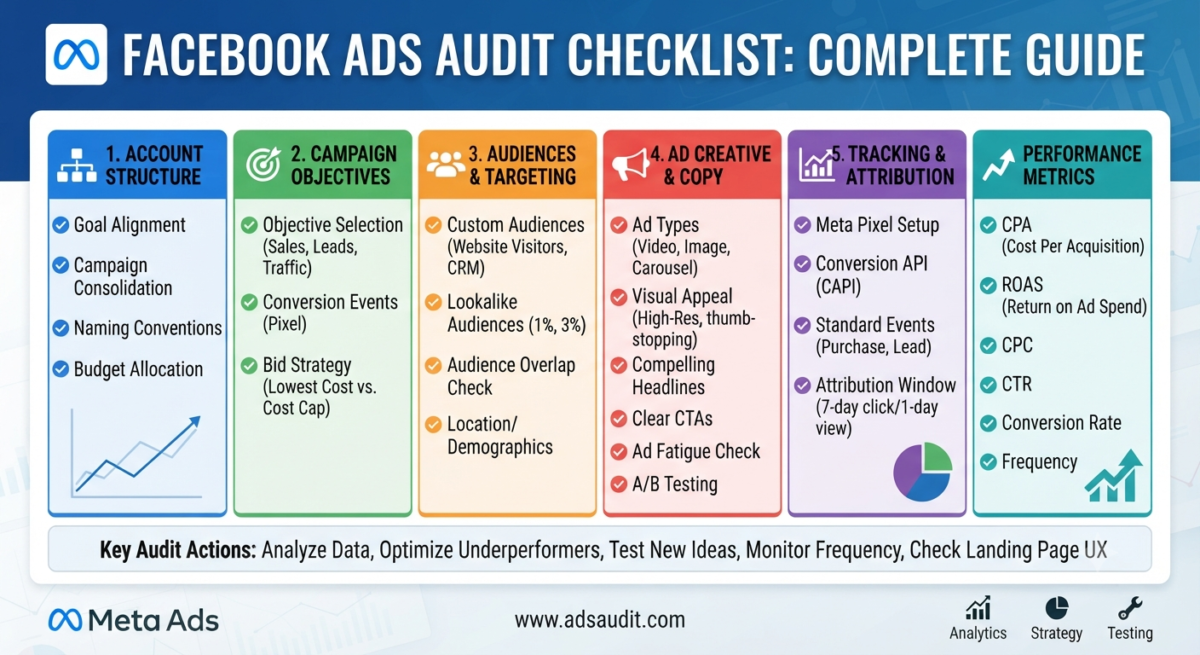
Running Facebook ads without reviewing their performance regularly is like driving a car without checking the fuel gauge or engine. You may reach your destination, but you’ll likely waste time, money, and opportunities along the way. A Facebook Ads Audit Checklist helps you evaluate every aspect of your advertising account, identify weak points, and uncover opportunities to improve campaign performance.
Whether you manage campaigns for a small business, an eCommerce store, or multiple clients, conducting regular audits ensures your advertising budget is being spent wisely. Instead of relying on assumptions, you can make informed decisions backed by data, resulting in better click-through rates, higher conversions, and improved return on investment.
In this guide, you’ll learn how to audit every important part of your Facebook advertising account, from campaign objectives and audience targeting to creative performance, tracking, budgeting, and optimization. By following these practical steps, you can build campaigns that consistently deliver measurable business results.
What Is a Facebook Ads Audit?
A Facebook Ads audit is a detailed review of your advertising account to evaluate whether your campaigns are performing as expected. It involves examining campaign settings, targeting options, creative assets, bidding strategies, conversion tracking, budgets, and reporting metrics to identify areas for improvement.
An audit isn’t only about finding problems. It’s equally valuable for discovering successful strategies that can be expanded and repeated across future campaigns. Businesses that perform routine audits typically make faster improvements because they rely on performance data instead of guesswork.
Regular audits also help ensure your campaigns remain aligned with your current marketing objectives. As business goals evolve, customer behavior changes, and Meta introduces new advertising features, your campaigns should adapt accordingly.
Simply launching ads isn’t enough anymore. Continuous optimization has become essential for maintaining profitability in today’s competitive advertising landscape.
Why You Need a Facebook Ads Audit Checklist
Many advertisers believe that once a campaign starts producing conversions, there’s no reason to make changes. In reality, campaign performance naturally declines over time as audiences become saturated, competition increases, and advertising costs fluctuate.
Using a structured audit process helps you detect these issues before they significantly impact your results.
A complete audit helps you identify unnecessary spending by highlighting campaigns that consume budget without producing meaningful conversions. Instead of increasing advertising costs, you can redirect your investment toward high-performing audiences and creatives.
An audit also improves campaign efficiency by identifying weak audience segments, ineffective ad creatives, poor landing page experiences, or inaccurate conversion tracking. Small improvements across several campaign components often produce significant gains in overall return on ad spend.
Another important advantage is maintaining consistency across your advertising account. Well-organized campaigns with clear naming conventions, logical structures, and accurate tracking are much easier to manage, especially as your business grows.
Perhaps the biggest benefit is confidence in your marketing decisions. Rather than making changes based on assumptions, you can optimize campaigns using measurable data that reflects actual customer behavior.
Facebook Ads Audit Checklist
Review Campaign Objectives
The first step in any audit is verifying that each campaign has been created with the correct objective.
Meta offers campaign objectives such as Awareness, Traffic, Engagement, Leads, App Promotion, and Sales. Selecting the wrong objective can significantly reduce campaign effectiveness because Meta’s algorithm optimizes delivery based on your chosen goal.
For example, if your primary objective is generating online purchases, running a Traffic campaign may increase website visitors without producing meaningful sales. A Sales campaign is designed to optimize for conversions rather than clicks.
Review every active campaign and ask yourself whether the selected objective still aligns with your current business goals. If your priorities have changed, updating campaign objectives should become a top priority.
It’s also important to avoid running multiple campaigns that compete for the same objective and audience simultaneously. This can increase costs through audience overlap and internal competition.
Check Audience Targeting
Even exceptional advertisements struggle when shown to the wrong audience. That’s why audience targeting deserves careful attention during every audit.
Begin by reviewing your saved audiences, custom audiences, and lookalike audiences.
Determine whether your targeting reflects your ideal customer profile. Consider demographics, geographic locations, interests, purchasing behavior, and customer intent.
Custom audiences built from website visitors, previous customers, email subscribers, or video viewers often outperform broad interest targeting because they consist of users already familiar with your business.
Lookalike audiences remain one of Meta’s strongest targeting options. However, they should be built using high-quality source data, such as recent purchasers instead of general website visitors.
Audience overlap is another common issue. When multiple campaigns target nearly identical users, they compete against each other during Meta’s auction process. This often increases advertising costs without improving overall performance.
Also review audience exclusions carefully. Excluding recent purchasers from prospecting campaigns prevents unnecessary spending while improving customer experience.
If your campaigns rely heavily on interest targeting, consider testing broader audiences supported by Meta’s machine learning capabilities. In many industries, broader targeting combined with strong creative assets now delivers better results than extremely narrow audience selections.
Analyze Ad Creative
Creative quality often determines whether users stop scrolling or ignore your advertisements completely.
During your audit, review every image, video, carousel, and headline currently running.
Ask whether each creative clearly communicates the problem your product or service solves. Strong advertisements focus on customer benefits rather than simply listing product features.
Evaluate image quality, branding consistency, messaging clarity, and overall visual appeal.
Videos should capture attention within the first few seconds. Long introductions frequently reduce viewer retention and increase advertising costs.
Your primary headline should immediately communicate value while encouraging users to learn more. Similarly, the primary text should remain concise, conversational, and easy to understand.
Review your call-to-action buttons as well. Whether your campaign uses “Learn More,” “Shop Now,” “Book Now,” or “Sign Up,” the CTA should match the customer’s stage within the buying journey.
Creative fatigue is another critical factor. Ads shown repeatedly to the same audience eventually lose effectiveness as users become accustomed to seeing them.
Monitoring frequency alongside click-through rate helps determine when it’s time to refresh creative assets. Regularly introducing new visuals, messaging, and formats keeps campaigns engaging while maintaining strong performance.
Evaluate Ad Placements
Placement optimization has a significant impact on campaign efficiency.
Meta offers automatic placements that distribute advertisements across Facebook, Instagram, Messenger, Audience Network, Reels, Stories, and other available inventory.
While automatic placements often perform well, they should still be reviewed regularly.
Analyze performance reports to determine where conversions originate. Some businesses generate exceptional results through Instagram Reels, while others achieve stronger conversion rates on Facebook News Feed or Stories.
If certain placements consistently produce higher costs with minimal conversions, consider excluding them after gathering sufficient performance data.
At the same time, avoid making placement decisions based on limited impressions. Allow campaigns to collect enough statistical significance before drawing conclusions.
Remember that different creative formats perform better in different placements. Vertical videos are ideal for Stories and Reels, while carousel ads often perform exceptionally well within the Facebook Feed.
A successful audit evaluates whether creative assets are properly matched to the placements where they appear.
Review Budget and Bidding
Your budget directly influences how often your ads are shown, while your bidding strategy determines how efficiently that budget is spent. During an audit, review whether your daily or lifetime budgets still align with your current business goals.
Campaigns that consistently deliver profitable results may deserve a higher budget, while campaigns with poor performance should be reduced, paused, or restructured. Increasing budget on underperforming campaigns rarely fixes the underlying issue. Instead, optimize targeting, creative, or landing pages before investing more money.
Next, examine your bidding strategy. Meta offers several bid options depending on campaign objectives, including Highest Volume, Cost Per Result Goal, Bid Cap, and ROAS Goal. Your chosen strategy should match your campaign goals. For example, an eCommerce store focused on profitability may benefit from a ROAS-based strategy, while a lead generation campaign may prioritize cost per lead.
Another important factor is budget distribution. Check whether one campaign is consuming most of the account budget while producing average results. Sometimes, reallocating a portion of that budget to higher-performing campaigns produces a much stronger overall return.
Seasonality also plays a role in budgeting. During holidays, promotional periods, or product launches, competition increases and advertising costs may rise. Planning budget adjustments in advance helps maintain campaign performance without overspending.
Check Conversion Tracking
One of the most overlooked parts of an advertising audit is conversion tracking. Even excellent campaigns cannot be optimized effectively if tracking is inaccurate.
Start by reviewing your Meta Pixel installation. Verify that the Pixel is firing correctly on every important page, including product pages, contact forms, checkout pages, and thank-you pages. Missing or duplicate events can significantly distort reporting.
Next, review your standard and custom events. Events such as Page View, View Content, Add to Cart, Initiate Checkout, Lead, and Purchase should be configured properly and reflect real customer actions.
If your business relies on online sales or lead generation, implementing the Conversion API (CAPI) is equally important. Unlike browser-only tracking, Conversion API sends data directly from your server to Meta, improving measurement accuracy despite browser privacy restrictions and cookie limitations.
Attribution settings should also be reviewed. Selecting the appropriate attribution window ensures conversions are credited accurately, allowing better optimization decisions.
Finally, compare Meta reporting with your analytics platform or CRM. Large discrepancies often indicate tracking issues that require immediate attention before making optimization decisions.
Reliable data forms the foundation of every successful Facebook advertising strategy.
Analyze Campaign Metrics
Performance metrics tell the real story behind every campaign. Looking beyond surface-level numbers helps identify exactly where improvements are needed.
Start with Click-Through Rate (CTR). A strong CTR generally indicates that your audience finds the ad relevant and engaging. If CTR is low, your creative, messaging, or targeting may require adjustments.
Next, evaluate Cost Per Click (CPC). Rising CPC often signals increasing competition, audience fatigue, or weak creative performance. Lower CPC isn’t always the ultimate goal, but consistently high costs should be investigated.
Cost Per Thousand Impressions (CPM) measures how expensive it is to reach your audience. While CPM varies by industry, sudden increases may suggest greater competition or poor audience quality.
Cost Per Acquisition (CPA) is one of the most valuable metrics because it measures how much you’re paying for each conversion. Compare CPA against your customer lifetime value to determine whether campaigns remain profitable.
Return on Ad Spend (ROAS) should receive close attention. High ROAS campaigns deserve further investment, while low-performing campaigns should be analyzed before additional budget is allocated.
Frequency is another essential metric. As frequency increases, users repeatedly see the same advertisement. Excessive frequency often leads to declining engagement and higher advertising costs due to creative fatigue.
Conversion Rate helps evaluate how effectively visitors complete desired actions after clicking your advertisement. If click-through rates remain strong but conversion rates decline, the problem may exist on the landing page rather than within the advertisement itself.
Instead of focusing on individual metrics in isolation, evaluate how they influence one another to gain a complete understanding of campaign performance.
Landing Page Review
Many advertisers spend hours optimizing Facebook ads while overlooking the page users visit after clicking the advertisement.
A landing page should continue the same message presented within the ad. If users expect one offer but arrive on an unrelated page, trust decreases and conversions suffer.
Begin by reviewing page loading speed. Slow websites increase bounce rates and reduce conversion opportunities, particularly for mobile users.
Next, evaluate the user experience. Navigation should be intuitive, important information easy to locate, and the overall design visually appealing without unnecessary distractions.
Mobile responsiveness deserves special attention because the majority of Facebook users browse on smartphones. Ensure text remains readable, buttons are easy to tap, and forms are simple to complete across all screen sizes.
Review your call-to-action placement as well. Visitors should immediately understand what action they are expected to take, whether that involves making a purchase, requesting a quote, scheduling an appointment, or downloading a resource.
Trust signals such as customer testimonials, certifications, secure payment icons, client logos, guarantees, and case studies can significantly improve conversion rates.
Finally, confirm that the landing page accurately reflects the promises made within the advertisement. Consistency builds confidence and improves overall campaign performance.
Check A/B Testing
Successful advertisers rarely rely on assumptions. Instead, they continuously test different campaign elements to discover what works best.
Review whether active campaigns include structured A/B testing.
Creative testing remains one of the most valuable optimization techniques. Compare different images, videos, headlines, primary text, and calls to action to identify which combinations generate the strongest results.
Audience testing is equally important. Testing different lookalike audiences, interest groups, age ranges, or geographic locations often reveals new opportunities for growth.
Placement testing can uncover where your audience engages most effectively. Although Meta’s automatic placements perform well in many situations, reviewing individual placement performance helps refine future campaigns.
Offer testing should also be included. Sometimes changing the promotional message, pricing strategy, discount structure, or value proposition produces a significant increase in conversion rate.
During an audit, verify that only one major variable changes per test. Testing multiple variables simultaneously makes it difficult to determine which change influenced the results.
A structured testing process transforms campaign optimization from guesswork into a data-driven strategy.
Review Account Structure
As advertising accounts grow, organization becomes increasingly important. A well-structured account allows faster reporting, easier optimization, and better collaboration among team members.
Review campaign naming conventions first. Campaign names should clearly describe objectives, audiences, products, dates, or promotional periods. Consistent naming saves valuable time during future audits.
Next, evaluate campaign hierarchy. Separate prospecting campaigns from remarketing campaigns to improve reporting clarity and budget management.
Check whether inactive campaigns should be archived or paused permanently. Removing outdated campaigns reduces clutter and simplifies account navigation.
Duplicate campaigns should also be reviewed carefully. Running multiple campaigns targeting nearly identical audiences can increase costs through internal competition.
Documentation is another valuable but often overlooked practice. Recording major campaign changes, budget adjustments, and optimization decisions helps identify what contributed to performance improvements over time.
A clean, organized advertising account supports better long-term management and more efficient decision-making.
Verify Compliance
Every audit should conclude with a review of Meta’s advertising policies. Even high-performing campaigns can stop generating results if they violate platform guidelines.
Review advertisements for restricted content, misleading claims, prohibited language, and inappropriate imagery. Ensure your messaging remains truthful, transparent, and supported by evidence whenever necessary.
If your business operates within regulated industries such as finance, healthcare, housing, employment, or politics, confirm that campaigns follow Meta’s specific advertising requirements.
Review ad approval history as well. Frequent disapprovals may indicate recurring compliance issues that should be corrected before launching future campaigns.
Privacy compliance is equally important. Verify that your website includes a clear privacy policy, cookie consent mechanism where applicable, and accurate disclosures regarding data collection practices.
Maintaining compliance protects your advertising account from unnecessary disruptions while building trust with both Meta and your target audience.
Common Facebook Ads Audit Mistakes
Even experienced advertisers can overlook critical details during an account review. One of the most common mistakes is focusing only on surface-level metrics such as impressions or clicks while ignoring business outcomes like leads, purchases, or return on investment. High traffic means little if it does not generate meaningful conversions.
Another frequent issue is making changes too quickly. Many advertisers pause campaigns or replace creatives before enough data has been collected. Meta’s algorithm requires sufficient learning time, and premature adjustments can prevent campaigns from reaching their full potential.
Ignoring audience overlap is another costly mistake. When multiple campaigns compete for the same users, advertising costs increase while overall efficiency declines. Regularly reviewing audience overlap helps avoid unnecessary spending.
Creative fatigue also goes unnoticed in many accounts. Advertisements shown repeatedly to the same audience gradually lose effectiveness, resulting in lower engagement and higher costs. Refreshing creatives on a regular schedule helps maintain strong campaign performance.
Finally, many businesses fail to review tracking accuracy. Decisions based on incomplete or inaccurate conversion data often lead to poor optimization choices. Before adjusting budgets or targeting, always confirm that your measurement system is working correctly.
Best Practices for Facebook Ads Optimization
Successful advertisers treat optimization as an ongoing process rather than a one-time task. Reviewing campaigns every month allows you to identify trends early and respond before performance declines.
Keep your creative assets fresh by introducing new images, videos, and messaging regularly. Updating creatives helps reduce audience fatigue and keeps engagement levels high.
Focus on meaningful performance indicators instead of vanity metrics. Prioritize conversions, cost per acquisition, customer lifetime value, and return on ad spend when evaluating campaign success.
Allow Meta’s machine learning enough time to optimize campaigns before making significant changes. Frequent adjustments can reset the learning phase and delay performance improvements.
Finally, document every optimization you make. Recording changes alongside performance results creates valuable historical data that can guide future advertising decisions and make your optimization process more efficient.
Free Facebook Ads Audit Template
A structured audit template helps you review your advertising account consistently instead of relying on memory or assumptions. Every audit should begin by confirming campaign objectives and then move through audience targeting, ad creatives, placements, budgeting, tracking, performance metrics, landing pages, testing, account organization, and compliance.
When reviewing your account, ask yourself whether each campaign is still aligned with your business goals. Check whether the audience is reaching the right people, whether the creative is engaging enough to capture attention, and whether your landing pages are delivering the experience users expect after clicking an ad.
Next, verify that conversion tracking is accurate through Meta Pixel and Conversion API. Compare advertising data with your analytics platform to ensure reported conversions match actual customer actions. Finally, document every finding, prioritize improvements based on business impact, and schedule your next audit. Performing this process monthly creates a cycle of continuous optimization that leads to stronger long-term performance.
At this stage, you should also expand your optimization efforts beyond the primary audit process. This is where strategies related to Facebook ads optimization, Meta Ads audit, Facebook campaign audit, Facebook ad account audit, Facebook advertising checklist, Facebook Ads performance audit, Meta Ads checklist, Facebook Ads ROI, and Facebook Ads optimization checklist become increasingly valuable. These supporting strategies help fine-tune campaigns after the initial audit and contribute to consistent improvements over time.
How Often Should You Audit Your Facebook Ads?
There is no universal schedule that works for every business, but consistency is essential. Businesses with high advertising budgets or multiple active campaigns should review their accounts every week to identify issues before they become expensive.
Small businesses running a limited number of campaigns can usually perform a comprehensive audit once every month while monitoring key metrics weekly.
Major business events should also trigger an immediate audit. Product launches, seasonal promotions, pricing updates, website redesigns, or significant shifts in consumer demand can all affect campaign performance. Reviewing your account during these periods ensures your advertising strategy remains aligned with current business objectives.
In addition, advertisers should perform an audit whenever they notice sudden changes in cost per acquisition, return on ad spend, click-through rate, or conversion volume. Early detection allows you to correct issues before they impact revenue.
Why Continuous Optimization Matters
A common misconception is that successful Facebook campaigns can run indefinitely without intervention. In reality, digital advertising is constantly evolving.
Customer behavior changes over time, competitors launch new campaigns, advertising costs fluctuate, and Meta regularly updates its algorithms and features. A campaign that performs exceptionally well today may gradually decline over the next few months if left untouched.
Continuous optimization allows advertisers to adapt to these changes instead of reacting after performance has already dropped. Small improvements made consistently often produce better long-term results than major account overhauls performed once or twice a year.
Optimization also helps businesses stay ahead of competitors. While many advertisers only react when campaigns stop working, proactive optimization creates a competitive advantage by identifying opportunities before others recognize them.
Successful advertisers view Facebook advertising as an ongoing process of testing, learning, measuring, and improving rather than a one-time setup.
Conclusion
Successful Facebook advertising depends on much more than launching attractive advertisements. Every campaign contains valuable insights that can only be uncovered through regular analysis and structured optimization.
A comprehensive audit helps you identify inefficient spending, improve audience targeting, strengthen creative performance, verify accurate tracking, optimize bidding strategies, and create a better customer journey from the first click to the final conversion.
Rather than making decisions based on assumptions, businesses that perform regular account reviews rely on measurable data to guide every optimization. This approach not only improves advertising performance but also increases profitability and creates a more sustainable digital marketing strategy.
Remember that even small improvements across multiple areas of your account can produce significant gains in return on investment. Consistency is the key to long-term success. By reviewing your campaigns regularly and implementing data-driven improvements, you can build an advertising system that continues to deliver better results month after month.
Why Choose Bhatti Marketing?
Managing profitable Facebook advertising campaigns requires experience, strategic planning, and continuous optimization. At Bhatti Marketing, we don’t simply launch ads—we build data-driven campaigns designed to generate measurable business growth.
Our team conducts comprehensive account audits, identifies hidden opportunities, improves audience targeting, creates high-converting ad creatives, optimizes campaign structures, and tracks every important conversion accurately. Whether you’re looking to generate more qualified leads, increase online sales, or improve your return on advertising investment, we develop customized strategies based on your business goals rather than generic templates.
We believe every advertising dollar should contribute to business growth. That’s why our optimization process focuses on continuous testing, performance analysis, and ongoing improvements that deliver long-term results.
Our Facebook Ads Case Studies
Real results speak louder than promises. Our Facebook advertising case studies demonstrate how strategic campaign optimization has helped businesses reduce advertising costs, improve lead quality, increase conversion rates, and achieve higher returns on ad spend across multiple industries.
Each case study highlights the challenges our clients faced, the optimization strategies we implemented, and the measurable outcomes achieved through data-driven decision-making. By analyzing real campaign performance, you can better understand how a structured advertising strategy contributes to sustainable business growth.
If you’re looking to improve your own advertising performance, explore our case studies to see how proven optimization techniques have delivered results for businesses similar to yours.
Ready to Improve Your Facebook Advertising Performance?
If your campaigns are generating clicks but not enough conversions, or your advertising costs continue to increase without delivering better results, it’s time for a professional review.
Bhatti Marketing provides comprehensive Facebook advertising audits, campaign optimization, audience research, conversion tracking setup, creative strategy, and ongoing account management designed to maximize your marketing investment.
Contact our team today for a personalized advertising strategy and discover how data-driven optimization can help your business generate more qualified leads, stronger customer engagement, and higher revenue through smarter Facebook advertising.
Frequently Asked Questions
How often should I review my Facebook advertising account?
Most businesses benefit from a full account review once a month. If you’re running multiple campaigns or spending a large budget, a weekly performance review helps identify issues early and keeps campaigns optimized.
Which metrics are the most important for measuring campaign success?
The most valuable metrics include Return on Ad Spend (ROAS), Cost Per Acquisition (CPA), Conversion Rate, Click-Through Rate (CTR), Cost Per Click (CPC), and Frequency. These metrics provide a complete picture of campaign performance and profitability.
Is Meta Pixel enough for accurate conversion tracking?
Meta Pixel is an excellent starting point, but combining it with Conversion API provides more reliable tracking. This setup improves data accuracy, especially after browser privacy updates that affect cookie-based tracking.
Why are my advertising costs increasing?
Higher costs can result from increased competition, audience fatigue, poor creative performance, limited audience size, seasonal demand, or changes in bidding strategy. Regular optimization helps identify the exact cause and reduce unnecessary spending.
How can I improve my ad creatives?
Focus on creating clear, benefit-driven messaging with high-quality visuals and a strong call to action. Refresh creatives regularly to avoid audience fatigue and test different formats such as videos, carousel ads, and static images.
What is audience overlap, and why does it matter?
Audience overlap occurs when multiple campaigns target the same users. This causes your campaigns to compete against each other in Meta’s auction, often increasing costs without improving results. Reviewing audience overlap during account optimization helps improve efficiency.
Should I use automatic or manual placements?
Automatic placements are recommended for most campaigns because Meta’s algorithm distributes your ads across placements where they are most likely to perform well. However, reviewing placement performance regularly helps identify opportunities for further optimization.
Why is my click-through rate high but conversions are low?
A high CTR with low conversions usually indicates an issue after users click your ad. Common causes include slow-loading landing pages, confusing navigation, weak calls to action, or messaging that doesn’t match the advertisement.
How long should I let a campaign run before making changes?
Avoid making significant changes during Meta’s learning phase. Allow enough time and data to accumulate before evaluating performance. Premature adjustments can interrupt optimization and produce inconsistent results.
Can small businesses achieve success with Facebook advertising?
Yes. Businesses of all sizes can achieve excellent results when campaigns are built around clear objectives, accurate tracking, relevant audience targeting, compelling creative assets, and continuous optimization.